

Key Takeaways
- Specialize in a niche to command higher rates and attract better clients
- Build a portfolio website even before landing your first client
- Set your rate based on value delivered, not hours worked
Freelancing offers the freedom to work on your own terms, choose your clients, and build a business around your skills. The freelance economy has grown explosively, with over 70 million Americans now freelancing at least part-time. Whether you're a writer, designer, developer, consultant, or virtual assistant, freelancing platforms connect you with clients worldwide who need your expertise.
Unlike traditional employment, freelancing lets you control your schedule, choose your projects, and potentially earn more than a salaried position. However, it also means managing your own taxes, finding clients, and handling the uncertainty of variable income. Understanding the landscape of freelancing platforms helps you find the right opportunities for your skills and goals.
Benefits of Freelancing
- Schedule Flexibility - Set your own hours and work when you're most productive. Night owl or early bird, you decide.
- Location Independence - Work from home, coffee shops, or while traveling. All you need is an internet connection.
- Unlimited Income Potential - No salary cap. Your earnings scale with your skills, rates, and capacity.
- Project Variety - Work on different projects with diverse clients instead of the same tasks repeatedly.
- Client Selection - Choose who you work with. Drop difficult clients and seek better ones.
- Skill Development - Constant exposure to new challenges accelerates learning and keeps work interesting.
- Tax Advantages - Deduct home office, equipment, software, and other business expenses.
Challenges of Freelancing
- Income Variability - Feast-or-famine cycles are common, especially starting out
- No Benefits - You're responsible for health insurance, retirement, and paid time off
- Self-Employment Taxes - Pay both employer and employee portions of Social Security/Medicare
- Client Acquisition - Constantly finding new clients requires ongoing effort
- Isolation - Working alone can be lonely without deliberate social connection
Top Freelancing Platforms
Upwork
The largest freelancing marketplace with millions of jobs posted annually across nearly every skill category - writing, programming, design, marketing, virtual assistance, and more. Upwork uses a bidding system where freelancers submit proposals for posted jobs. The platform charges freelancers a flat 10% service fee on earnings — it retired the older 5–20% sliding-scale structure in 2023.
Fiverr
A gig-based platform where freelancers create service listings (called "gigs") that clients browse and purchase directly. Unlike Upwork, clients come to you based on your gig visibility. Starting prices begin at $5 (hence the name), though most successful freelancers earn much more through upsells and premium packages. Fiverr takes a flat 20% of every transaction. Works best for productized services with clear deliverables - logo design, video editing, voice-overs, writing services with defined outputs.
Toptal
An exclusive network claiming to represent the top 3% of freelance talent. Toptal is best for highly experienced developers, designers, finance experts, and project managers who can pass rigorous screening (technical tests, live interviews, test projects). In exchange for selectivity, Toptal clients pay premium rates and freelancers keep more of their earnings. No public fee structure - rates are negotiated per engagement. Ideal for senior professionals seeking high-paying enterprise clients.
Freelancer.com
A large marketplace with both traditional job postings and contest-based projects. Contests let multiple freelancers submit work, with only the winner getting paid - useful for building a portfolio but risky for time investment. The platform charges 10% or $5, whichever is greater. Good for beginners building initial reviews and portfolio pieces through smaller projects.
99designs
Specialized platform for graphic designers offering both contest-based work and direct client hiring. Designers can participate in logo, branding, web design, and packaging contests or be hired directly by clients seeking specific expertise. Commission is built into pricing, with designers receiving 50-75% of contest awards. Perfect for visual designers, illustrators, and brand specialists.
LinkedIn Services Marketplace (formerly ProFinder)
Connects freelancers with businesses through LinkedIn's professional network. Clients post project requests, and matched freelancers can submit proposals. Particularly effective for consultants, coaches, accountants, lawyers, and professionals whose LinkedIn profiles demonstrate credibility. No platform fees - you pay for LinkedIn Premium to access proposals.
FlexJobs
Curated job board featuring vetted remote, part-time, freelance, and flexible positions. FlexJobs screens every listing for legitimacy, eliminating scams common on free job boards. Requires a subscription ($9.95/week to $59.95/year) but delivers higher-quality opportunities from legitimate companies.
We Work Remotely
One of the largest remote work job boards, featuring full-time and contract positions from companies committed to remote work. Popular with tech companies and startups. Jobs are posted by employers who pay listing fees, so freelancers browse free.
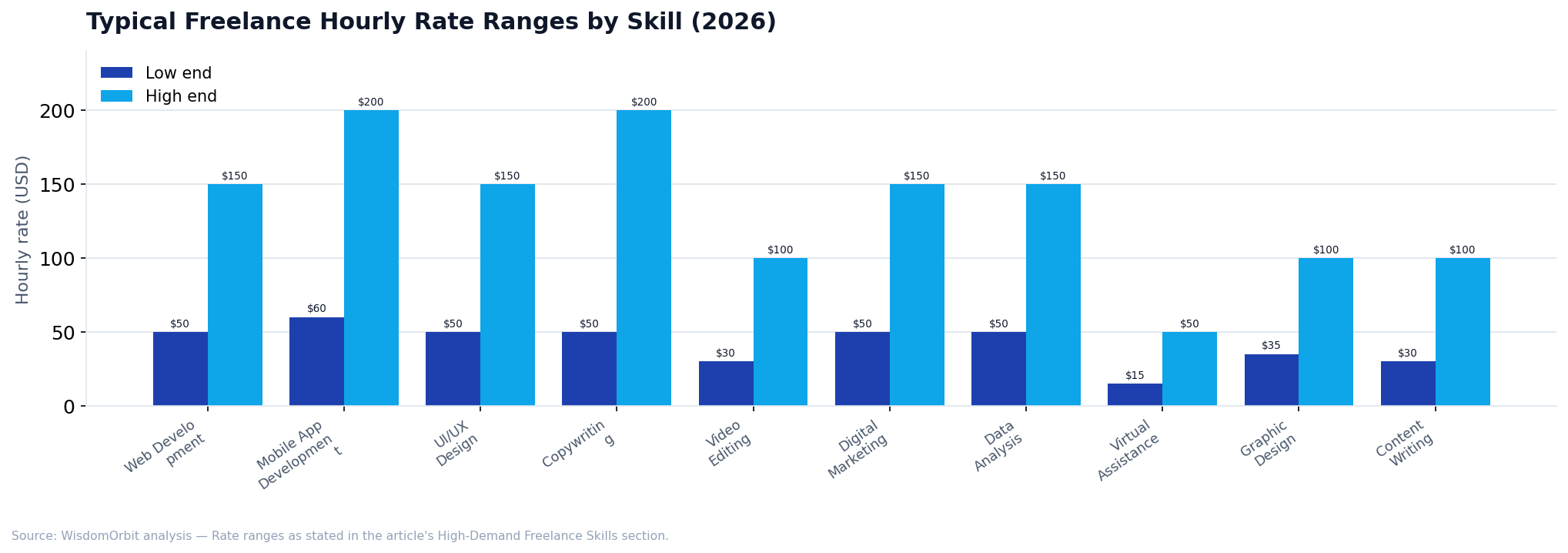
High-Demand Freelance Skills
- Web Development - $50-150/hour; full-stack, frontend, or backend specializations
- Mobile App Development - $60-200/hour; iOS, Android, or cross-platform
- UI/UX Design - $50-150/hour; wireframing, prototyping, user research
- Copywriting - $50-200/hour; sales pages, email sequences, ads
- Video Editing - $30-100/hour; YouTube, social media, commercial content
- Digital Marketing - $50-150/hour; SEO, PPC, social media management
- Data Analysis - $50-150/hour; SQL, Python, visualization tools
- Virtual Assistance - $15-50/hour; administrative support, scheduling, research
- Graphic Design - $35-100/hour; logos, branding, marketing materials
- Content Writing - $30-100/hour; blogs, articles, website copy
Platform Fees Comparison
- Upwork - Flat 10% freelancer service fee
- Fiverr - 20% flat rate on all transactions
- Toptal - Variable (built into client rate, typically lower than marketplaces)
- Freelancer.com - 10% or $5, whichever is greater
- 99designs - Built into pricing (designers receive 50-75% of project value)
- LinkedIn Services Marketplace (formerly ProFinder) - No platform fee; requires LinkedIn Premium subscription
Setting Your Rates
Pricing is one of the biggest challenges for freelancers. Consider these approaches:
- Hourly Rates - Best for ongoing or unpredictable scope work. Calculate based on desired annual income, business expenses, and billable hours.
- Project-Based Pricing - Quote a fixed price for defined deliverables. Protects you if you work efficiently but requires accurate scope estimation.
- Value-Based Pricing - Charge based on the value you deliver to the client, not hours worked. A landing page that generates $100,000 in sales is worth more than a few hours of your time.
- Retainer Agreements - Ongoing monthly arrangements providing predictable income for you and priority access for clients.
Tips for Freelancing Success
- Build a strong portfolio - Showcase your best work prominently. Include case studies showing results, not just pretty pictures.
- Start competitive, raise rates strategically - Begin with rates that get you hired, then increase as you gain reviews and proven results.
- Communicate proactively - Under-promise and over-deliver. Keep clients informed of progress without being asked.
- Meet deadlines religiously - Reliability is rare. Being consistently on-time differentiates you from most freelancers.
- Specialize in a niche - "Copywriter for SaaS companies" commands higher rates than "general copywriter."
- Ask for testimonials - Request reviews from every satisfied client. Social proof drives future sales.
- Diversify income sources - Don't rely on a single platform or client. Build multiple income streams.
- Invest in yourself - Continually upgrade skills through courses, books, and practice.
Building Your Freelance Business
Getting Your First Clients
The hardest part of freelancing is landing initial clients without reviews or testimonials. Strategies include: offering discounted rates for first clients in exchange for testimonials, doing small projects for people in your network, creating spec work for your portfolio, and actively bidding on smaller jobs to build reviews quickly.
Transitioning from Employee to Freelancer
Many successful freelancers start by freelancing on the side while employed, building client relationships and savings before going full-time. Aim for 3-6 months of expenses saved and at least one consistent client before leaving employment.
Frequently Asked Questions
How much can freelancers earn?
Income varies enormously by skill, experience, and effort. Beginners might earn $1,000-3,000/month; experienced freelancers often earn $5,000-15,000/month; top performers exceed $20,000/month or more. Your ceiling depends on your rates, capacity, and ability to find high-value clients.
Is freelancing stable?
Less stable than employment in terms of predictable paychecks, but potentially more stable in that you're not dependent on a single employer. Diversified client bases reduce risk from any single client leaving.
Do I need an LLC to freelance?
Not required to start, but forming an LLC provides liability protection and potential tax benefits as you grow. Consult with an accountant once earning consistently.
Getting Started
Identify your most marketable skills and research going rates in your niche. Create profiles on 2-3 platforms that match your skills and goals. Build a portfolio showcasing your best work, even if it's from personal projects or spec work. Start with competitive rates to build reviews, then gradually increase as your reputation grows. Treat freelancing like a business from day one - track finances, invest in skills, and focus on delivering exceptional value to every client.
You May Also Like


Sources & References
- IRS – Self-Employment Tax Guide
- U.S. Bureau of Labor Statistics – Independent contractor and gig economy statistics
- Upwork – Freelance Forward Survey
- Freelancers Union – Freelance industry reports and resources