

The online education market is booming, expected to reach $350 billion by 2027. Creating an online course allows you to package your expertise into a scalable product that generates passive income while helping students achieve their goals from anywhere in the world.
Unlike trading time for money through consulting or services, online courses let you teach thousands of students simultaneously without additional effort. Course creators regularly build six and seven-figure businesses by solving specific problems and delivering transformation to their students.
Why Create Online Courses?
Online courses offer unique advantages over other business models:
- Passive Income - Create once and sell repeatedly for years. While "passive" requires upfront work and ongoing marketing, each additional sale requires minimal effort.
- Unlimited Scalability - No limit on students. Whether you have 10 or 10,000 students, the delivery cost remains essentially the same.
- Authority Building - A course positions you as the expert in your field, opening doors to speaking engagements, consulting, and other opportunities.
- High Profit Margins - After initial creation costs, margins often exceed 80-90%. No inventory, manufacturing, or shipping costs.
- Impact at Scale - Help more people than you could through one-on-one work. Your teaching reaches students while you sleep.
- Location Independence - Run your course business from anywhere with an internet connection.
What Makes a Successful Online Course
The most successful courses share these characteristics:
- Clear Transformation - Students know exactly what they'll achieve by completing the course
- Specific Target Audience - Designed for a defined group with a specific problem
- Practical, Actionable Content - Students can apply what they learn immediately
- Structured Learning Path - Logical progression from beginner to competent
- Multiple Learning Formats - Video, text, worksheets, quizzes to accommodate different learning styles
- Community or Support - Students can ask questions and connect with peers
Best Course Platforms
Teachable
Teachable is one of the most popular all-in-one course platforms, hosting over 100,000 creators. It handles course delivery, payment processing, student management, and basic marketing tools. The platform is known for its user-friendly interface and reliable video hosting.
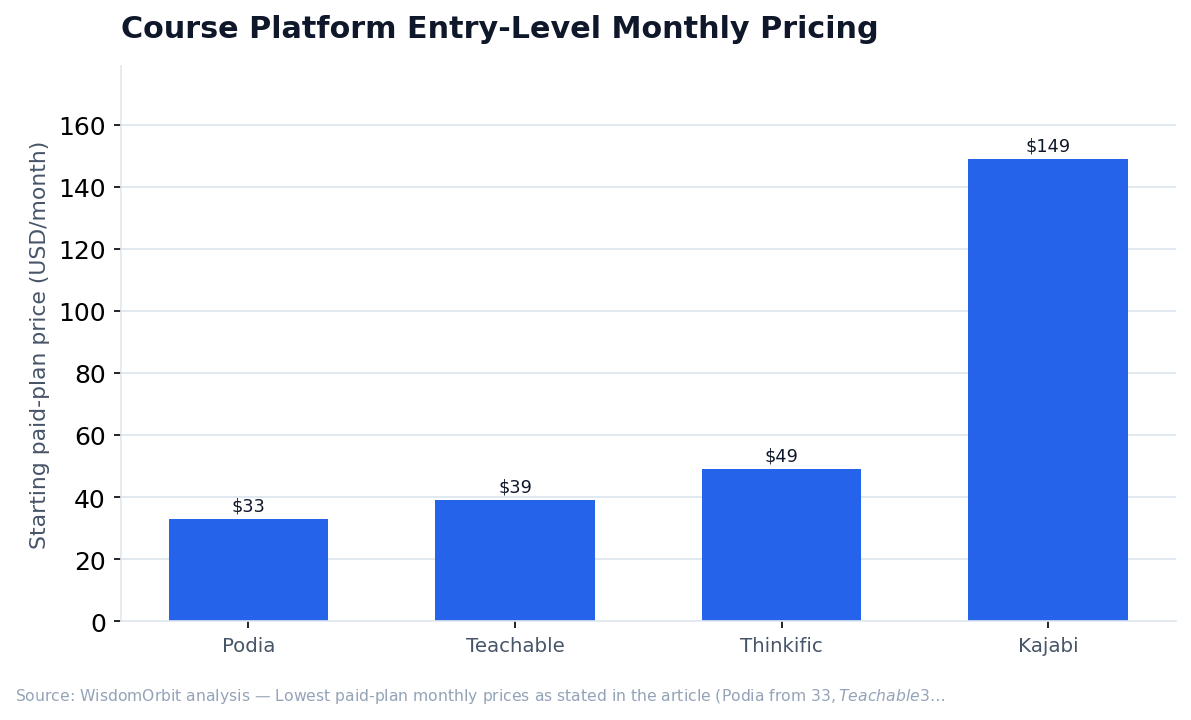
The free plan allows unlimited students with $1 + 10% transaction fees. Paid plans ($39-119/month) reduce or eliminate transaction fees and add features like advanced reports, certificates, and priority support.
Best for: Beginners and intermediate course creators wanting a balanced, user-friendly platform.
Thinkific
Thinkific offers similar capabilities to Teachable with more design customization options. The platform excels at creating branded course websites and offers a robust free plan that includes unlimited courses and students (with Thinkific branding).
Paid plans ($49-99/month) remove branding, add memberships, assignments, and advanced student analytics. Thinkific doesn't charge transaction fees on any plan, making it more economical at scale.
Best for: Creators wanting more control over their course site design without coding.
Kajabi
Kajabi is the premium all-in-one solution for serious course businesses. Beyond course hosting, it includes a complete website builder, email marketing automation, sales funnels, membership sites, and a mobile app for students. The platform eliminates the need for separate tools like Mailchimp, Leadpages, or WordPress.
Plans start at $149/month with no transaction fees. While expensive, Kajabi can replace $300+/month in separate software subscriptions.
Best for: Established course creators wanting an all-in-one platform to run their entire business.
Udemy
Udemy operates as a marketplace with over 50 million students, giving you instant access to a massive audience. However, Udemy controls pricing (often discounting courses to $10-20 during sales) and takes a significant revenue share (37-75% depending on how students find your course).
It's free to publish on Udemy, making it a good option for beginners to test course ideas and build an audience. Many creators use Udemy for visibility while selling premium courses on their own platform.
Best for: Beginners testing course ideas, or creators wanting additional passive income alongside their main platform.
Podia
Podia offers courses, digital downloads, memberships, and webinars in one simple platform. The interface is exceptionally clean, and they offer excellent customer support. Plans start at $33/month with no transaction fees.
Best for: Creators wanting simplicity and those selling multiple product types (courses + downloads + memberships).
Skool
Skool combines course hosting with community features in a gamified platform. Members earn points for engagement, creating motivation and retention. It's particularly effective for courses that rely heavily on community and accountability.
Best for: Courses with strong community components, coaching programs, and memberships.
Steps to Create Your Course
Step 1: Validate Your Course Idea
Before creating content, confirm people will pay for your course:
- Survey your existing audience about their biggest challenges
- Research competitor courses and their reviews
- Pre-sell the course before creating it (validate with money, not just interest)
- Create a mini-version or webinar to test engagement
Step 2: Define Learning Outcomes
Clearly articulate what students will be able to do after completing your course. Specific outcomes like "build a WordPress website from scratch" sell better than vague promises like "learn web development."
Step 3: Outline Your Curriculum
Structure your course into modules and lessons:
- Start with the end transformation and work backward
- Break the journey into 4-8 modules
- Each module should have 3-8 lessons
- Include practical exercises and action items
Step 4: Create Your Content
For video lessons, you don't need expensive equipment to start:
- Camera - Smartphone with good lighting works fine initially
- Microphone - A $50-100 USB microphone dramatically improves quality
- Screen Recording - Use Loom, Camtasia, or ScreenFlow for tutorials
- Editing - iMovie, DaVinci Resolve (free), or hire editors on Fiverr
Step 5: Set Up Your Course Platform
Upload content, configure payment processing, and create your sales page. Most platforms offer templates to make this straightforward.
Step 6: Launch and Market
A successful launch typically includes:
- Email sequences to your list
- Social media content building anticipation
- Free webinar or workshop leading to the offer
- Limited-time bonuses or early-bird pricing
- Testimonials from beta students
Course Pricing Guide
Price based on the transformation value, not hours of content:
- Mini-Course ($27-97) - Solves a small, specific problem. 1-2 hours of content. Good for lead generation.
- Standard Course ($197-497) - Comprehensive transformation. 5-15 hours of content. Most common price range.
- Premium Course ($997-2,000+) - Complete system with personal support, community, or coaching calls. 10-30+ hours plus bonuses.
- High-Ticket Program ($3,000-10,000+) - Includes significant coaching or done-with-you elements.
- Membership ($29-99/month) - Ongoing access to content library and community. Requires consistent new content.
Marketing Your Course
- Email Marketing - Build a list with free lead magnets related to your course topic
- Content Marketing - Blog posts, YouTube videos, podcasts that demonstrate expertise
- Webinars - Free training that leads to your course offer (often 5-15% conversion)
- Affiliates - Partner with influencers who promote your course for commission
- Paid Advertising - Facebook, Instagram, YouTube ads to drive traffic to webinars or sales pages
- SEO - Rank for terms people search when looking for solutions you provide
Frequently Asked Questions
How long should my course be?
Length matters less than results. Students want transformation, not hours of content. A focused 3-hour course that delivers results beats a 30-hour course full of filler. Aim for the minimum content needed to achieve the promised outcome.
Do I need to be an expert?
You need to be ahead of your students, not necessarily an industry-recognized expert. If you've achieved something your target audience wants to achieve, you can teach the process. Document what you know, not what you're still learning.
How much can I make selling courses?
Income varies wildly. Some creators make a few hundred dollars; top creators earn millions annually. With a quality course, engaged audience, and consistent marketing, $50,000-200,000/year is achievable within 2-3 years for dedicated creators.
Should I create a course or a membership?
Courses provide one-time revenue with less ongoing work. Memberships provide recurring revenue but require consistent new content and community management. Many creators start with a course, then add a membership for graduates.
Getting Started
Start by identifying a specific problem you can solve and validating that people will pay for the solution. Create a simple course on Teachable or Thinkific's free plan, launch to a small audience, and iterate based on feedback before investing in premium platforms or heavy marketing.
You May Also Like


Sources & References
- U.S. Department of Education – Online learning regulations and standards
- Research.com – Online education statistics and trends
- Class Central – MOOC and Online Course Reports
- Statista – E-learning market size and growth projections