

Key Takeaways
- Ahrefs and SEMrush are the industry standards for competitive analysis
- Free tools like Google Search Console provide essential baseline data
- Focus on one tool and learn it deeply rather than subscribing to many
Search engine optimization is essential for driving free, targeted traffic to your website. Organic search accounts for over 50% of all website traffic, making it the largest single source of visitors for most businesses. The right SEO tools help you find keywords people are searching for, track your rankings, analyze what competitors are doing successfully, and identify technical issues that may be holding your site back from ranking.
While Google's algorithm considers hundreds of factors, SEO tools give you data-driven insights that inform strategy and measure progress. Without tools, you're essentially optimizing blind - guessing what works rather than knowing. Whether you're managing a single site or dozens for clients, the right tools dramatically improve your efficiency and results.
What SEO Tools Help You Do
- Keyword Research - Discover what terms people search for, how often they search, how difficult those terms are to rank for, and related opportunities you might miss.
- Rank Tracking - Monitor where your pages appear in search results over time, across different locations and devices.
- Competitor Analysis - See which keywords competitors rank for, where they get backlinks, and what content performs best in your niche.
- Site Audits - Identify technical SEO issues like broken links, slow page speed, crawl errors, duplicate content, and missing meta tags.
- Backlink Analysis - Track who links to your site, discover link opportunities, and identify potentially harmful links.
- Content Optimization - Get recommendations for improving on-page SEO to better match search intent and compete with top-ranking pages.
- Traffic Estimation - Estimate how much organic traffic competitors receive and the value of that traffic.
Top SEO Tools Compared
Ahrefs
Ahrefs maintains the largest backlink database in the industry, crawling the web constantly and indexing trillions of links. This makes it the go-to tool for link building campaigns and backlink research. Site Explorer shows any website's complete backlink profile, organic keywords, traffic estimates, and top-performing pages. Content Explorer helps find link-worthy content ideas based on what's already getting shared and linked.
Ahrefs' keyword research tools show difficulty scores, click-through rate estimates, and parent topic groupings that help prioritize opportunities. The site audit feature catches technical issues with clear explanations and priority scores. For link building and competitive analysis, Ahrefs is hard to beat.
Best for: Link building, backlink analysis, and competitive research.
SEMrush
An all-in-one marketing toolkit that extends beyond SEO to include PPC research, social media tools, and content marketing features. SEMrush excels at competitive analysis, showing which keywords competitors bid on in paid search alongside organic rankings. The Keyword Magic Tool generates thousands of related keyword ideas with extensive filtering options.
SEMrush's Position Tracking monitors rankings across locations and devices with daily updates. The Content Template and SEO Writing Assistant tools help optimize content as you write. For agencies managing multiple clients and needing comprehensive reporting, SEMrush offers extensive white-label customization.
Best for: All-in-one marketing needs, agencies, and competitive intelligence.
Moz Pro
Known for creating the Domain Authority metric that became an industry standard for estimating site strength, Moz offers a more beginner-friendly interface than Ahrefs or SEMrush. Their keyword research tools include helpful SERP feature analysis, showing which queries trigger featured snippets, local packs, or image carousels. Link Explorer provides backlink analysis with spam score indicators.
Moz's site crawl feature checks for technical issues with clear, actionable recommendations. The free MozBar browser extension lets you see DA scores and page-level metrics as you browse. Moz Local helps local businesses manage citations and listings. While less comprehensive than competitors, Moz's approachability makes it valuable for SEO beginners.
Best for: Beginners, local SEO, and teams wanting accessible tools.
Surfer SEO
Surfer specializes in content optimization using AI-powered analysis of top-ranking pages. Rather than guessing what to include in content, Surfer analyzes the top 10-20 results for your target keyword and provides specific recommendations: word count targets, keyword frequency, semantic terms to include, heading structure, and more.
The Content Editor scores your content in real-time as you write, showing what's missing and what's overdone. Grow Flow provides weekly optimization tasks based on your site's data. For content teams and writers who need to produce SEO-optimized content efficiently, Surfer dramatically improves the process.
Best for: Content creators, writers, and teams focused on on-page optimization.
Ubersuggest
Neil Patel's SEO tool offers a generous free tier with keyword research, site audits, rank tracking, and backlink data. While data depth doesn't match premium tools, Ubersuggest provides enough functionality for small businesses and beginners to start optimizing without significant investment. Paid plans are more affordable than competitors.
Best for: Budget-conscious users, beginners, and small businesses.
Google Search Console
The only SEO tool that shows actual data directly from Google - which queries bring impressions and clicks, average positions, click-through rates, and which pages get indexed. Search Console is essential for every website owner regardless of what other tools you use. It's also free.
Beyond performance data, Search Console alerts you to manual actions, security issues, crawl errors, and mobile usability problems. You can submit sitemaps, request indexing for new pages, and inspect how Google sees specific URLs. No other tool provides this direct connection to Google.
Best for: Everyone. It's free and provides irreplaceable data.
Screaming Frog
A desktop-based SEO spider that crawls websites to find technical issues. The free version handles up to 500 URLs; the paid version removes that limit. Screaming Frog finds broken links, redirect chains, duplicate content, missing meta tags, thin content, and dozens of other technical problems. Exports detailed reports for fixing issues or client deliverables.
Best for: Technical SEO audits and large site analysis.
Key Features to Compare
- Keyword Database Size - Larger databases mean more keyword suggestions and better data accuracy. Ahrefs and SEMrush have the largest.
- Backlink Index - Freshness and completeness of backlink data matters for link building. Ahrefs leads here.
- Rank Tracking - How frequently rankings update (daily vs. weekly), how many keywords you can track, and location/device options.
- Site Audit Depth - How many issues the crawler checks for and how actionable the recommendations are.
- Reporting - White-label options for agencies, scheduled reports, and customization capabilities.
- API Access - For building custom integrations, automating workflows, or pulling data into other tools.
- Projects/Sites - How many sites you can manage on each plan level.
Pricing Comparison
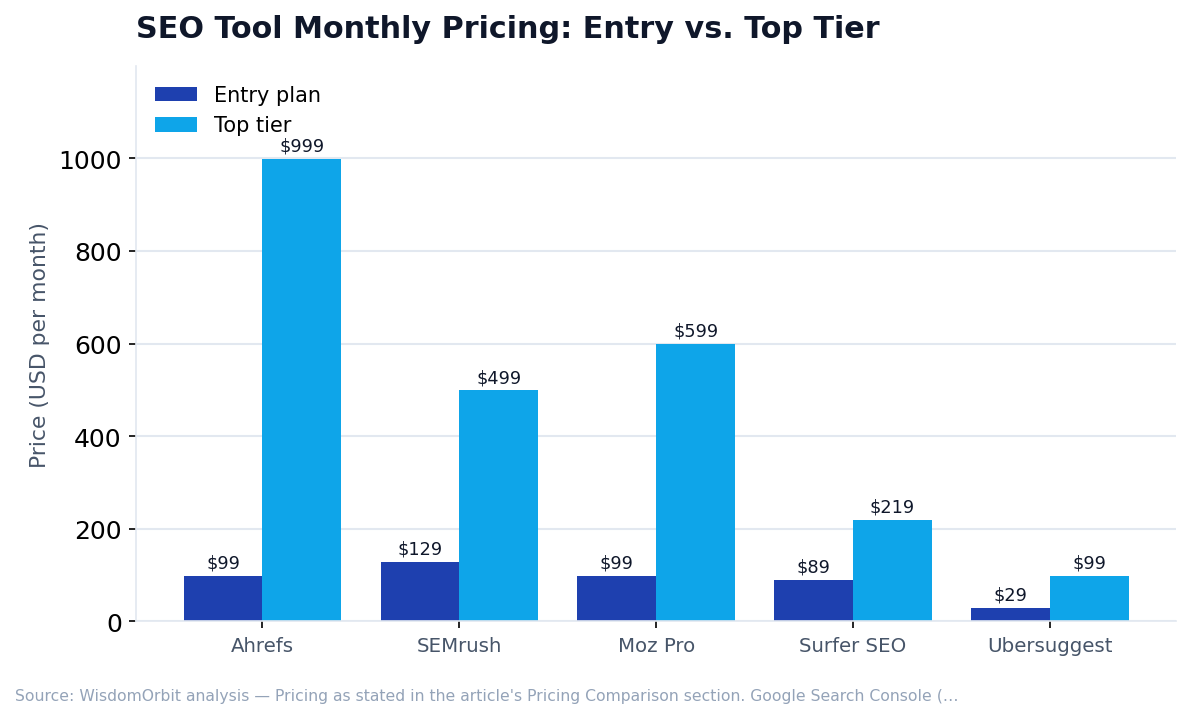
- Ahrefs - $129-1,499/month (Lite to Enterprise; a limited Starter plan is $29/month)
- SEMrush - $129-499/month (Pro to Business)
- Moz Pro - $99-599/month (Standard to Premium)
- Surfer SEO - $89-219/month (Essential to Enterprise)
- Ubersuggest - Free limited; $29-99/month paid
- Google Search Console - Free
- Screaming Frog - Free up to 500 URLs; $259/year unlimited
Most tools offer annual discounts of 15-20%. Starting with monthly billing lets you test before committing.
Which Tool Should You Choose?
- Link Building Focus - Ahrefs. Best backlink database and link building features.
- All-in-One Marketing - SEMrush. Covers SEO, PPC, social, and content.
- Beginners - Moz Pro or Ubersuggest. More approachable interfaces with educational resources.
- Content Writers - Surfer SEO. Real-time optimization guidance while writing.
- Budget-Conscious - Ubersuggest + Google Search Console. Covers basics affordably.
- Agencies - SEMrush or Ahrefs. Both offer agency-specific features and reporting.
- Technical SEO - Screaming Frog. Deep technical audits at a reasonable price.
Free SEO Tools Worth Using
- Google Search Console - Direct search performance data from Google. Essential.
- Google Analytics - Traffic analysis, user behavior, and conversion tracking.
- Bing Webmaster Tools - Similar to Search Console but for Bing.
- Screaming Frog (free up to 500 URLs) - Technical audits for smaller sites.
- AnswerThePublic - Content ideas based on questions people ask.
- Google PageSpeed Insights - Page speed analysis with specific recommendations.
- Mobile-Friendly Test - Check how pages render on mobile devices.
- Rich Results Test - Validate structured data markup.
Frequently Asked Questions
Do I need paid SEO tools?
You can do SEO with free tools alone, but paid tools save significant time and provide data you can't get elsewhere. If SEO is important to your business, paid tools typically pay for themselves through better results and efficiency.
Can I use multiple SEO tools together?
Yes, and many professionals do. For example, using Ahrefs for backlink research, Surfer for content optimization, and Google Search Console for performance data combines each tool's strengths.
How long before SEO shows results?
Typically 3-6 months for meaningful results, though it varies based on competition, your site's authority, and the quality of optimization. SEO tools help you track progress even before rankings improve dramatically.
Getting Started
Start with Google Search Console - it's free and essential. Add Google Analytics for traffic analysis. From there, choose a paid tool based on your priorities: Ahrefs for link building, SEMrush for comprehensive marketing, or Surfer for content optimization. Most tools offer trials or limited free access to help you evaluate before committing. Focus on actually using the data rather than just collecting it - the best tool is one you actively work with.
You May Also Like


Sources & References
- Google – Google Search Central Documentation
- Moz – SEO Research and Industry Studies
- Ahrefs – SEO Data Studies
- Search Engine Journal – SEO best practices and algorithm updates