

Getting funding for your startup is one of the biggest challenges founders face. With over 90% of startups failing, securing the right capital at the right time can mean the difference between building a successful company and running out of runway. Understanding your funding options helps you choose the path that aligns with your business stage, growth goals, and how much ownership you're willing to give up.
The startup funding landscape has evolved significantly, with more options than ever for founders. From traditional venture capital to modern alternatives like revenue-based financing, each funding source comes with its own advantages, requirements, and tradeoffs. The key is matching the right funding type to your specific situation.
Types of Startup Funding
Bootstrapping
Self-funding using personal savings, credit cards, or revenue from initial sales. Bootstrapping keeps you in complete control with 100% equity, but growth may be slower due to limited capital. Many successful companies including Mailchimp, Basecamp, and GoPro started as bootstrapped ventures.
Bootstrapping works best when you can reach profitability quickly without massive upfront investment. It forces discipline and customer focus from day one. However, it may not work for businesses requiring significant capital for R&D, inventory, or market capture where speed matters.
Friends and Family
Early funding from your personal network, typically ranging from $10,000 to $100,000. This is often the first outside money startups raise, as friends and family invest based on their belief in you rather than detailed business metrics.
Always keep these arrangements professional with proper documentation including terms, expectations, and what happens if the business fails. Using SAFEs (Simple Agreements for Future Equity) or convertible notes protects both parties. Be honest about risks - you don't want to damage important relationships if the startup doesn't succeed.
Angel Investors
High-net-worth individuals who invest their own money in early-stage startups, typically $25,000 to $500,000 per investment. Angels often are successful entrepreneurs themselves who provide valuable mentorship and connections beyond just capital.
Angel investors usually invest at the pre-seed or seed stage when the business is too early for venture capital. They typically receive equity ownership in exchange for their investment, often targeting 10-20x returns over 5-10 years. Angels may invest individually or through angel groups where they pool resources and share due diligence.
Venture Capital
Institutional investors managing funds from limited partners (pension funds, endowments, wealthy individuals) who invest in high-growth potential startups. VCs invest larger amounts than angels but have higher expectations for growth and returns.
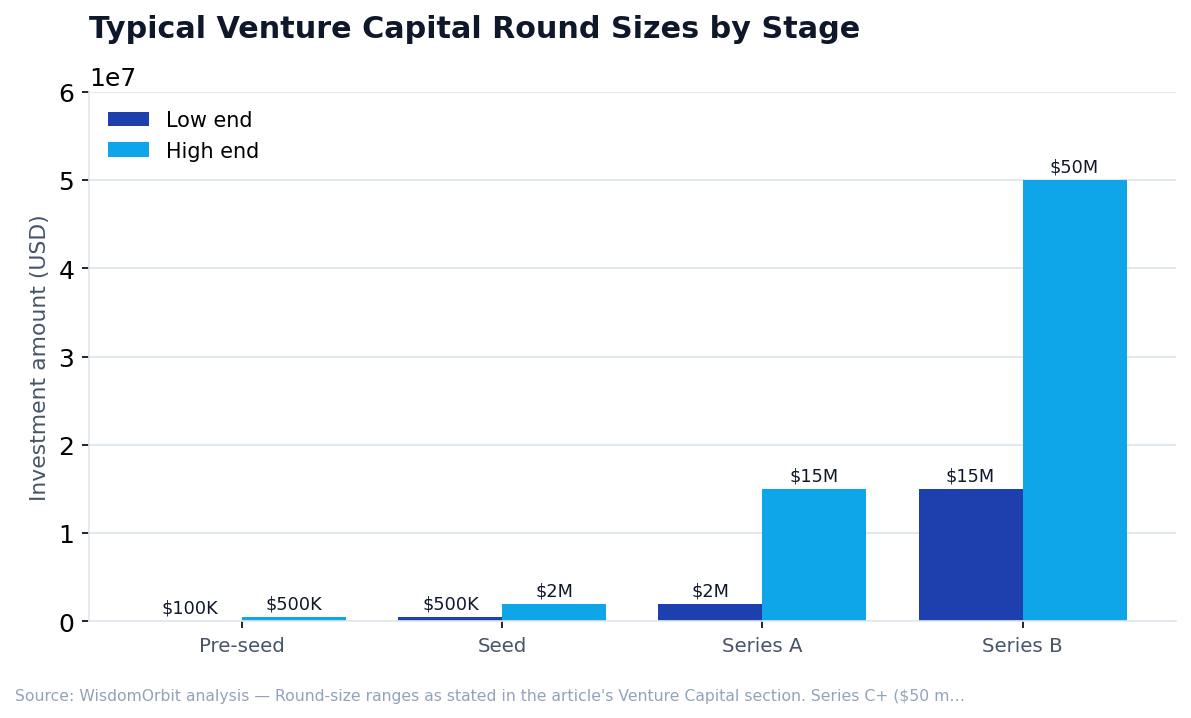
- Pre-seed - $100,000 to $500,000 for validating initial concept
- Seed - $500,000 to $2 million for building product and initial traction
- Series A - $2 million to $15 million for scaling proven model
- Series B - $15 million to $50 million for market expansion
- Series C+ - $50 million+ for global scale or pre-IPO
Venture capital is best suited for businesses with potential to reach $100 million+ in revenue and provide 10x+ returns. VCs expect fast growth and eventual exit through acquisition or IPO. If your business is profitable but not high-growth, VC may not be the right fit.
Alternative Funding Sources
Small Business Grants
Free money from government agencies, corporations, and foundations that doesn't need to be repaid. Grants are highly competitive and often have specific requirements (minority-owned, women-owned, specific industries, research focus). Common sources include SBIR/STTR federal grants for R&D, state economic development programs, and corporate innovation grants.
Crowdfunding
Raising money from many people through online platforms. Reward-based platforms like Kickstarter and Indiegogo work well for consumer products where backers receive the product in exchange for funding. Equity crowdfunding platforms like Republic and StartEngine allow companies to sell actual shares to the public.
Revenue-Based Financing
Receive upfront capital in exchange for a percentage of future revenue until a set amount is repaid (typically 1.3x-2x the original amount). Unlike equity financing, you don't give up ownership. Unlike loans, payments flex with your revenue. Companies like Clearco, Pipe, and Capchase offer this model, particularly suited for subscription and e-commerce businesses.
Startup Accelerators
Programs that provide funding, mentorship, and resources in exchange for equity (typically 5-10%). Top accelerators like Y Combinator (standard deal: $125,000 for 7% plus $375,000 on an uncapped SAFE), Techstars, and 500 Startups also provide invaluable networking with investors and other founders. The real value often comes from the connections and guidance rather than just the capital.
SBA Loans
Government-backed loans through the Small Business Administration offer favorable terms including lower interest rates, longer repayment periods, and smaller down payments than traditional bank loans. SBA 7(a) loans go up to $5 million for general business purposes. Requirements include time in business, revenue history, and personal guarantees.
Where to Find Investors
- AngelList - The largest network of angel investors and startup jobs. Syndicates allow angels to co-invest in deals.
- Crunchbase - Research which investors fund companies in your industry and stage. Study their portfolio companies.
- LinkedIn - Direct outreach to investors, though warm introductions convert better than cold messages.
- Pitch Competitions - Events where startups present to judges and investors. Great for exposure even if you don't win.
- Accelerator Demo Days - Top accelerators host events where portfolio companies pitch to hundreds of investors.
- Industry Conferences - Network at events specific to your sector where relevant investors attend.
What Investors Look For
- Strong Founding Team - Relevant experience, complementary skills, ability to execute. Team is often weighted more heavily than the idea at early stages.
- Large Market Opportunity - VCs typically want markets with $1 billion+ potential. Show your Total Addressable Market (TAM) and realistic path to capture it.
- Traction and Growth Metrics - Evidence that customers want what you're building. Revenue growth, user growth, engagement metrics, or waiting lists.
- Defensible Competitive Advantage - What prevents competitors from copying you? Network effects, proprietary technology, regulatory advantages, or brand.
- Clear Path to Profitability - Understanding of unit economics and how the business becomes profitable at scale.
- Reasonable Valuation - Expectations aligned with stage and traction. Overpriced rounds make future fundraising difficult.
Preparing to Raise
- Pitch Deck - 10-15 slides covering problem, solution, market, traction, team, and ask
- Financial Projections - 3-year forecasts showing how you'll use funds and expected growth
- Cap Table - Current ownership structure and impact of new investment
- Data Room - Organized documents (incorporation, contracts, metrics) for due diligence
Frequently Asked Questions
How much equity should I give up?
Industry standard is 15-25% per funding round. Giving up too much early leaves little for later rounds and employee equity. Founders should retain majority control through at least Series A.
When should I raise funding?
Raise when you have evidence of traction but need capital to scale faster. Raising too early with no proof points means worse terms or no funding. Raise 12-18 months of runway to give yourself time to hit milestones for the next round.
How long does fundraising take?
Plan for 3-6 months from first conversations to money in bank. The process includes initial meetings, follow-ups, due diligence, term sheet negotiation, and legal documentation. Keep running your business during fundraising.
Getting Started
Start by honestly assessing your funding needs and what you're willing to give up. Not every business needs venture capital - many great companies are built through bootstrapping or modest outside investment. Research investors who fund companies at your stage and in your industry, secure warm introductions when possible, and remember that fundraising is a process of finding the right partner, not just any check.
Sources & References
- U.S. Small Business Administration – Funding Programs Overview
- National Venture Capital Association – VC Industry Statistics
- Crunchbase – Startup funding data and trends
- SEC – Small Business Capital Raising
Related Articles
This article is for general information only and is not financial, legal, or tax advice. Verify current rates, fees, and terms with providers before making decisions.